


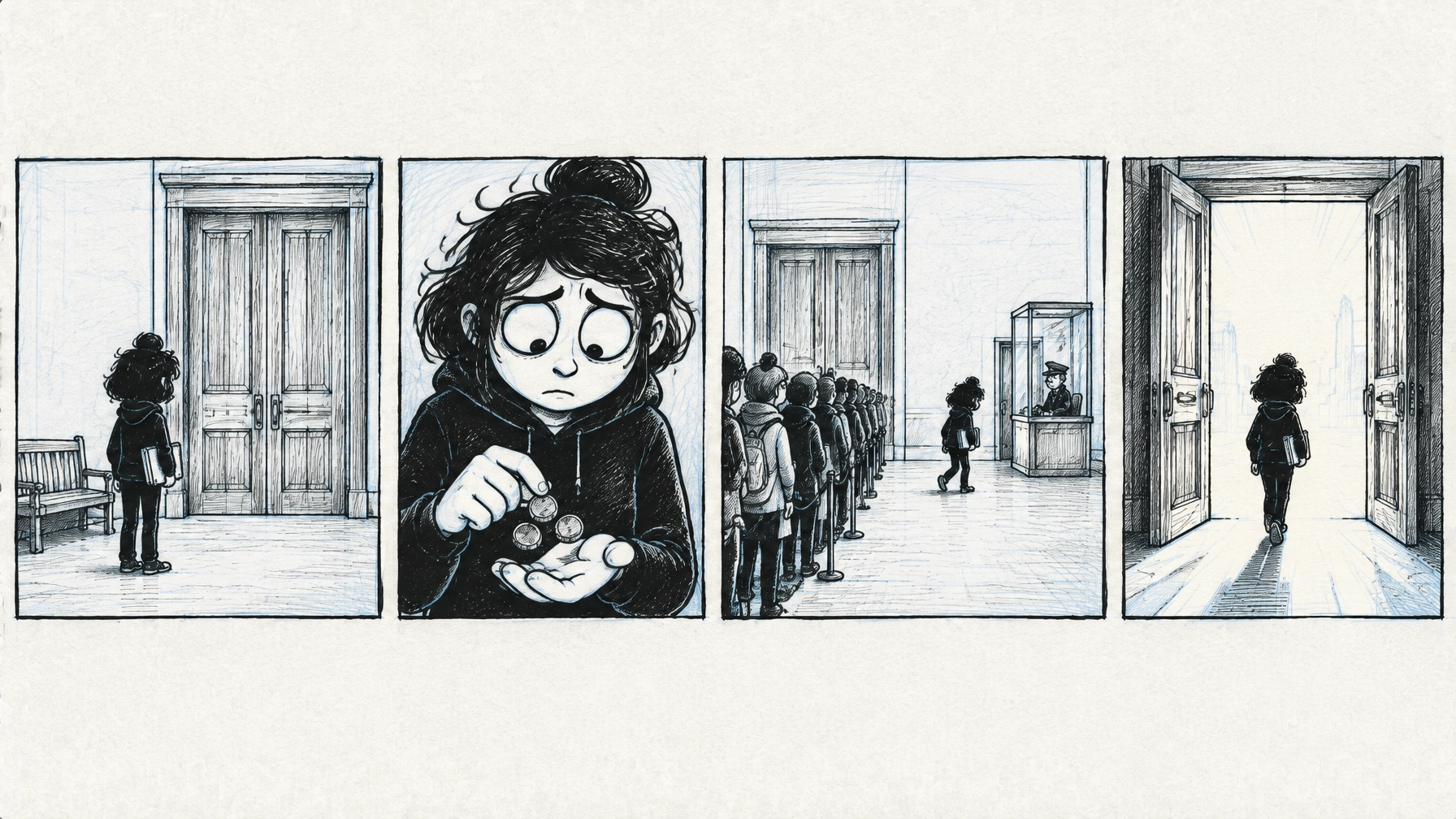
The Cost of Being Read
Open Process · The Orchard Project
The Orchard Project has been free to apply to since 2021. It costs us about $30,000 a year to read every submission with care, and a $15 fee, in line with much of the field, would cover most of it. So as we reopen our application system for 2027, we asked ourselves a real question: should we start charging? Before touching a single form, we went looking at what the evidence says application fees actually do, to artists and to the programs that charge them.
What we found surprised us. Not because the fees are large. Because they aren't. Six dollars. Fifteen. Thirty-five. Yet the research on what small costs do to who shows up is some of the most consistent in behavioral economics, and it keeps saying the same thing: the size of the fee is almost beside the point.
What the Field Charges
Across theater, residencies and film, paying $15 to $45 to be considered is the norm, and film runs higher. Sundance's development track charges $45, Yaddo $40, MacDowell $30 and the O'Neill $15, and across 4,631 festivals Stephen Follows found average fees running from about $30 for an early short to $87 for a late feature.

Chart: fee per application, selected programs, 2026–27 cycles. Film figures are average late-deadline fees across 4,631 festivals. Yaddo, MacDowell and the O'Neill offer waivers on request.
Sources: program application pages for the 2026–27 cycles and Stephen Follows' analysis of 4,631 festivals
A handful of programs hold the line at zero. Creative Capital, which drew 4,546 applications for its 2026 awards, keeps its open call free. Page 73 meets the playwrights it works with through a free application. NAMT charges nothing to writers who make its early deadline. A free open call can run at real scale.
How Big Is the Fee Economy?
Nobody publishes a total, so this is a rough estimate from public numbers. Film festivals worldwide collect something like $20 million to $60 million a year in entry fees, enough to sustain whole platforms. In theater, even a program with more than a thousand applicants collects only tens of thousands of dollars.
| Corner of the field | Volume | Typical fee | Rough take | How I got there |
|---|---|---|---|---|
| Film festivals, worldwide | 12,000+ festivals and contests on FilmFreeway alone | $30–$87 | $20-60m a year | Tiered estimate: ~200 major festivals × ~1,500 paid entries × $45, ~2,000 mid-size × ~200 × $35, ~8,000 small × ~30 × $25. Cross-check: the top U.S. festival in tax filings reports about $500K in fees |
| Sundance Film Festival | About 15,000 submissions (2020) | Median about $72.50 | About $1M a year | before waivers |
| The Black List website | 130,000+ evaluations and 100,000+ scripts hosted since 2012 | $100 per read, $30 a month to host | $6.5M–$13M in evaluations since 2012, plus hosting | 130,000 reads × $50 (early price) to $100 (current) |
| Academy Nicholl Fellowships | 5,599 entries (2023) | $50–$90 | $280K–$500K that year | 5,599 × $50–$90 |
| O'Neill National Playwrights Conference | About 1,650 entries | $15 | About $25K a year | 1,650 × $15, before waivers |
The Math on the Artist's Side
No one applies to one thing. An artist building a career sends work to a dozen or more opportunities a year. Twelve applications at $35 comes to $420 before anyone has read a page. A filmmaker running a short through twenty festivals at the average fee of $30 to $55 spends between $600 and $1,100.
Now set that against what writers earn. The Authors Guild surveyed 5,699 published authors and found a median book income of $2,000 in 2022, and $5,000 counting all writing-related work. For Black authors, the median book income was $800. A $420 application season is a fifth of the first number and more than half of the second.
Playwrights fare no better. Outrageous Fortune, TDF's study of 250 playwrights, found that 62 percent earned under $40,000 a year from all sources, and only 15 percent of their income came from theatrical work. For an artist living on those numbers, a season of fees isn't a rounding error. It's groceries. And the people most likely to decide they can't afford it are the people the field says it most wants to hear from.
Six Dollars and a Rule of Thumb
The cleanest evidence comes from a policy change almost nobody noticed. Until 1997, students taking the ACT could send their scores to three colleges for free, and each additional report cost $6. Then the ACT made the fourth report free. Amanda Pallais, an economist at Harvard, found that the share of students sending exactly four reports went from under 5 percent to almost 75 percent. They applied to more colleges, and low-income students enrolled at more selective ones. Her explanation is the part I keep returning to: students seemed to read the number of free reports as advice about how many places to try.
A fee is never only a price. It's a sentence about who the door is for.
Behavioral economists have documented the other half. Kristina Shampanier, Nina Mazar and Dan Ariely showed that people treat zero not as a low price but as a different kind of offer: move a choice from one cent to free and behavior shifts far more than cost-benefit math predicts. Free doesn't just cost less. It reads differently.

Chart: share taking part, comparison group vs. group with the barrier lowered. Each study lowered a different barrier: a fee, a form, or both. Ontario versions without fee waivers had negligible effects.
Sources: Pallais (2015); Oreopoulos & Ford via J-PAL; Bettinger et al. (2012) via J-PAL; Finkelstein & Notowidigdo (2019)
The pattern holds in very different rooms. In the H&R Block experiment, tax preparers helped low-income families complete the federal student aid form in about eight minutes; filing and college enrollment both rose, while information alone had no measurable effect. In Pennsylvania, offering eligible seniors help with the SNAP application tripled enrollment. None of these barriers was large. Each one was enough.
The Doorman Problem
Most programs that charge offer waivers, and that's good. But a waiver is a door with a doorman. You have to know it exists, ask for it, sometimes justify your need, and often do it on someone else's calendar. MacDowell takes waiver requests in a set window weeks before its deadline. Yaddo asks artists to get in touch at least three weeks ahead. The O'Neill has offered a limited number of waivers first-come, first-served. And across small theater contests, the most common waiver goes to members of the Dramatists Guild, which means the relief flows to writers who are already inside a professional institution. None of this is unusual, and none of it is meant to exclude; it's simply how waivers are built.
The college research is blunt about what that costs. In the Expanding College Opportunities trial, Caroline Hoxby and Sarah Turner sent high-achieving, low-income students no-paperwork fee waivers along with clear information. These students already qualified for waivers; the experiment simply removed the asking. At a cost of about $6 per student, recipients submitted 48 percent more applications and were 56 percent more likely to apply to a college matched to their record.
In Ontario, Philip Oreopoulos and Reuben Ford ran in-class application workshops in high schools where few students went on to college. The version with fee waivers raised application rates by 20.4 percentage points. The versions without them had negligible or even negative effects. Same workshops, comparable schools, randomly assigned. The difference that mattered was whether someone still had to pay.
What Fees Do to the Programs That Charge Them
Fees shape institutions too, and not always where you'd expect. Chill Subs, which tracks thousands of literary magazines, found that about 13 percent of all magazines charge to submit, rising to 56 percent among the 100 most popular. The most career-making opportunities are often the most expensive to try for, and writers pay anyway, because that's where the attention is. A fee can also work as a signal of prestige: if it costs something to get in, it must be worth getting into.
Film offers a check on the idea that fees keep the lights on. When Stephen Follows went through the tax returns of U.S. film festivals, he found that three-quarters earned less than 11 percent of their income from fees, and the oldest festivals took about 7 percent. A few outliers lean on them hard; one reported 82 percent. For most, the fee is a small line that carries a large signal. The average festival he studied offered 37.5 different fee options.
There's also a quiet transfer underneath the arithmetic. A program that charges $30 and receives 2,000 applications for ten slots collects $59,700 from the 1,990 artists it turns away. The many fund the reading of the few.
The encouraging news is that the field is moving. The O'Neill's National Playwrights Conference charged $35 in 2016 and charges $15 for 2027, after publicly setting a goal of bringing it down. NAMT made its on-time Festival of New Musicals submissions free starting in 2020. MacDowell suspended its reference-letter requirement to reduce barriers. Colleagues are already changing the structure. The question is how far it goes.
The Best Case for a Fee
The defenders of fees have a real argument, and it deserves a fair hearing. A small charge discourages careless submissions. Some festival programmers recommend charging something even when they could afford not to, simply so applicants read the rules.
The research partly backs them up. Pallais found that the students who sent an extra score report once it became free were about half as likely to be admitted as typical applicants. In Ontario's second round, fee waivers raised applications but not enrollment. In a large SNAP experiment, Amy Finkelstein and Matthew Notowidigdo found that the people brought in by outreach and application help were, on average, less needy than those who enrolled on their own. Remove the friction and you do get more marginal cases. That's true, and reading them is a real cost someone has to carry.
But look at what the filter is actually selecting for. A study of 3,727 Australian medical research grant proposals found that more time spent on a proposal did not raise its chance of success, and researchers' own rankings of their proposals didn't match the reviewers'. Effort and confidence aren't talent. A fee filters for liquidity and nerve, and both run thin among exactly the artists who are early. Pallais, for her part, still estimated that the extra report was worth more than $10,000 to the average low-income student who sent it. The marginal application is cheap to read. The missed artist is expensive.
Other Ways to Pay for the Read
If fees are the wrong tool, the cost of reading is still real, and someone has to carry it. The field has more options than charge or don't.
Charge for a service, not for consideration. The Black List website is the best-known model. Writers pay $30 a month to host a script and $100 for an evaluation, of which the reader keeps $60. The money buys a deliverable, not a ticket to be judged. WGA members can list scripts without hosting them, high scores earn free hosting and reads, and Franklin Leonard has said the company gave away more than 2,000 months of hosting and evaluations in a single year. It isn't free, and it draws criticism for that. But the line it draws is useful: pay for feedback if you want it, never for the chance to be seen. For a development program, one version is a free application with optional paid notes, written by a separate team so the two never touch.
Make the first round light. Creative Capital's first round asks for a short project proposal, four short answers and one work sample, at no cost. Only advancing applicants do more. A light first stage cuts the cost of reading and the hours artists pour into applications they won't win. Asking for less up front isn't lowering the bar.
Let someone else pay. When Tubi partnered with the Black List on a horror screenwriting initiative, it covered one evaluation and a month of hosting for each of 100 writers. Sponsors, foundations and individual donors can underwrite reads directly, which turns the fee from a toll into a gift.
Open more than one door. The Nicholl Fellowships now take scripts through 55 partner organizations alongside two public portals. Partners and nominators reach artists who would never find an open call, though they work best alongside an open door, not instead of one. The Nicholl's public portals also cap entries, which controls reading costs without charging anyone but rewards the artists who know the calendar, which is its own kind of doorman.
Why We Turn Over Every Rock
Which brings me back to us. Last year, 1,700 artists sent their work to The Orchard Project, and every application was read by a paid reader. We could pass that cost along and break even. We've decided not to.
Free to apply doesn't mean easy to get in. Most of those 1,700 artists heard no. Our labs are small, and selection is as hard as anywhere. That's the point. The job of a development program isn't to admit more people. It's to find the artists no one has found yet: early, unconnected, not yet sure they belong in anyone's pool. You can't find them in a pool that has already filtered itself by who could spare $35 and who felt confident enough to spend it. For a program whose whole job is discovery, a fee is a strange thing to charge. It asks the artist's bank account to do part of the search.
If the goal is to identify great artists, you have to turn over every rock.
We also try to make the "no" worth something. Because we can't take on every project we admire, we hold limited open office hours for artists whose work we couldn't support this year, a chance to talk through their submission and their work with our team. Many come back the next year with a stronger draft. We'd rather earn our credibility by what we do for artists where they are now than by how many we turn away. As we re-open our system for 2027, some of the ideas above are on our list. Charging artists to be considered isn't.
The value of a development program has always been measured by who it chooses. I've started to think that's only half the ledger. What if the most important thing a program does happens before it chooses anyone, in who it convinces to try?
If you run a program that charges, I'm not asking you to feel guilty about it. I'm asking a narrower question. Who isn't applying right now, and what would it cost to find out? And maybe more importantly: what is your fee telling them about who the door is for?
Keep the Door Open
This fall, we are launching The Open Door, a campaign to fund the full cost of reading every submission for the year ahead. Every $15 reads one artist's work, and returning donors are matched dollar for dollar while the match lasts.
If you've ever applied to OP, you know what it meant to send your work somewhere without paying for the privilege. If you never have, you can still be part of the reason the next playwright gets read. Open a door →