


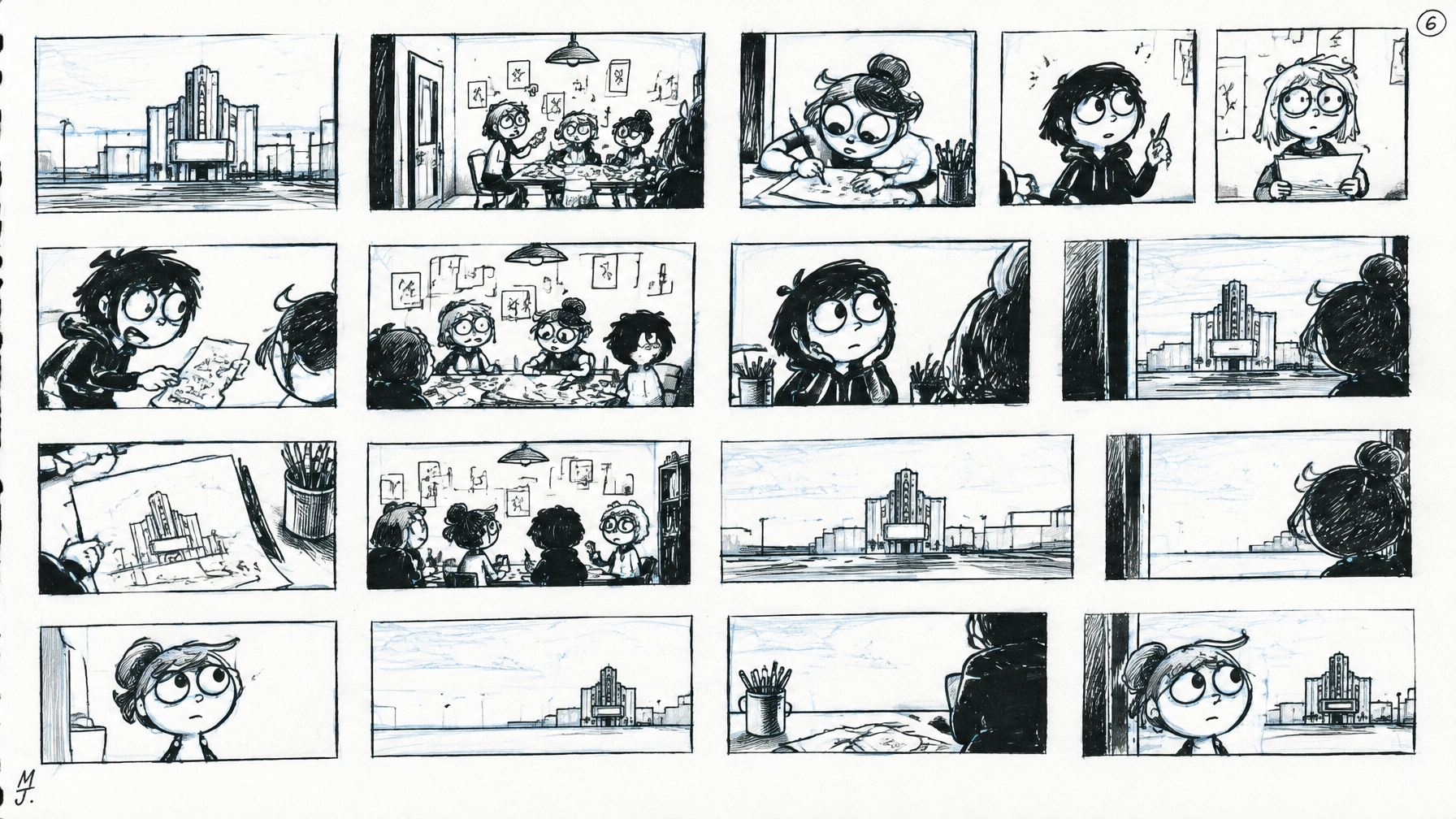
Maybe The Building Isn’t the Movement
Ahead of next week’s reckoning over the end of nonprofit theater: where the gala money goes, what we gave up when we stopped carrying risk, and why a small organization like ours is growing.
Next Tuesday, September 29, the DeVos Institute and Out of Hand Theater will gather seventeen respondents, Oskar Eustis among them, around a single question: is the American nonprofit theater movement over (link to join here: https://www.devosinstitute.net/initiative/is-the-american-nonprofit-theater-movement-over/?utm_source=substack&utm_medium=email))? Eustis set that question loose in July, when he announced he would step down from the Public in 2028 and told The New York Times, “I think the American nonprofit theater movement is over.” The consensus that built the field, he told the Los Angeles Times a few days later, is gone. “It’s not coming back.”
The field has spent the summer arguing with him, which, as the blog Theatre Upstanders noted this week, is its own kind of proof of life. Truly dead movements don’t usually bicker this much about their own obituaries.
I’ve been following that argument from an odd vantage point. At The Orchard Project, we’re growing. We now support fifty projects a year across our various labs, and we operate year round and across multiple verticals and media. In a year when institutions many times our size are cutting staff and shortening seasons, that seems worth asking about, and not as a victory lap. Why would a small artist-development organization with no marquee stage be expanding while the field’s flagships contract?
I think the answer has to do with what’s actually dying. So I don’t want to argue with Eustis. I think he’s right. I just want to be more precise about what’s ending.
Where the gala money goes
Last year, an Off-Broadway theater I’d worked with before as a director invited me in to talk about collaborating. At some point I asked what a show cost these days for an eight-week run.
For a small play, one or two actors, somewhere around $600,000 to $700,000. A medium-sized cast would run north of $1 million.
I asked how they could possibly afford that. They told me they looked for roughly 30 percent enhancement from a commercial producer on each show ($180,000 to $210,000 on the small play, $300,000 or more on the larger one). Even so, I asked, how much do you have to raise to cover what the box office can’t? Their answer surprised me. They budgeted each production to break even once the enhancement came in, and priced the tickets accordingly.
I had spent years assuming that a good share of a theater’s contributed revenue went to the work itself. So where, I asked, does the gala money go? The foundation grants?
“That pays for our staff the rest of the year.”
That one sentence is the crisis in miniature. Nobody in that room was a villain. They were doing exactly what the structure asks of them. The shows had been de-risked to the point of paying for themselves, and the philanthropy had quietly migrated from the art to the institution around it. Follow the same curve to its far end and you reach the newest version of enhancement, the so-called “non-priority loan,” through which commercial producers now underwrite as much as half the cost of a major musical at some of our largest nonprofits and are paid back from the first weeks of profit.
So what is the point of being a nonprofit if we’ve de-risked the work so thoroughly, and routed so much of our resources into institutional scaffolding, that we can’t actually take risks anymore? If our competitive advantage isn’t the ability to shoulder risk, what is it?
The species that won’t make it
Not every nonprofit theater is in trouble in the same way. But the ones in the most danger tend to share three traits.
Their money flows toward the institution rather than the work: the building, the overhead, the capital campaign for a new lobby in the same year artist fees stay flat. Their identity lives at an address; take away the building and there isn’t much left to rally around. And nothing they’ve built escapes the walls. No network of artists who stay connected after closing night, no infrastructure other people can use, no relationships that outlast the run.
That isn’t a moral failing. It’s the logic of an architecture. The regional theater movement set out to give artists a home. What it built instead were homes for institutions, which became permanent while the artists who filled them stayed temporary. Call it the great inversion. The building was supposed to serve the movement. Somewhere along the way, the movement started serving the building.
Nobody carries a card for a building

Consider the ACLU. It has a headquarters most people couldn’t find on a map, and its identity has never lived there. People know what it stands for and whose side it’s on. It works through affiliates in every state and members who proudly call themselves card-carrying. If its headquarters closed tomorrow, the ACLU would still be the ACLU.
For the opposite case, look at Washington this month. The Kennedy Center, our national cultural center, is closed after a fight that has come down to whose name belongs on the facade. It’s tempting to read that as a story about one administration. I think it’s also a story about architecture. When an institution is its building, whoever controls the building controls the institution. What the Kennedy Center was actually for: the orchestra, the free performances, the artists who spent this year deciding whether to walk through its doors, doesn’t live in the marble. Those are the parts worth defending, and they’re the parts no one can rename.
Why we’re growing

Which brings me back to The Orchard Project. My best answer is that for nearly twenty years we’ve spent our resources on the part the market won’t touch: the unfinished.
Thousands of artists have come through our labs, and their work has moved on to stages, screens and speakers across the country. But the projects aren’t the most important thing we’ve built. The relationships are. Something happens when artists are given permission to be unfinished together. They see one another’s work before the world does. They eat together, argue, recommend collaborators. A playwright ends up next to a television writer. A conversation over breakfast becomes a project three years later. And then people don’t want to leave. They don’t need another residency. They want to stay part of the community.
That has pulled us into producing support, fiscal sponsorship, professional development, pathways between theater, television and audio, and the unglamorous work of keeping several thousand artists useful to one another. None of it lives at an address. All of it is risk: bets placed on artists and ideas before anyone else has decided they’re worth it. I think that’s why it’s growing. It’s the one thing the field still needs that almost nobody else is built to provide.
Clubhouse or instrument

When a model starts failing, the instinct is defensive. How do we win back subscribers? Replace lost philanthropy? Hold on to the same number of productions? Those questions are necessary, but they skip the one underneath them:
What are these places actually for: a handsome room where longtime supporters can find one another at intermission, or an instrument for changing the world?
Loyal donors are the reason many of our institutions exist, and they deserve better than to be treated as the problem. But an institution whose shows pay for themselves, and whose philanthropy pays for itself, has quietly chosen to be a clubhouse.
The movement was never the buildings. It was the willingness to bet on artists before anyone else would. So the question I’d want in the room next Tuesday isn’t whether that movement is over. It’s who is still willing to carry the risk. And, maybe more importantly, whether the rest of us will fund the people who do.
- Ari Edelson, Founding Artistic Director, The Orchard Project
Leave a Reply