


Open Process: Who’s Actually Taking the Risk Right Now?
There is a quiet shift happening in the theater world, not necessarily in the work itself, which remains as inventive and unpredictable as ever, but in who is actually moving it forward.
Over the past few months, in conversations about developing new plays and new musicals, we at The Orchard Project have noticed something that at first felt anecdotal and now feels harder to ignore. The early energy, the push, the "this has to happen" vibe, the willingness to stick a flag in something before it's fully legible, is very often coming from commercial producers.
Not always. Not everywhere. But enough that it starts to register as a pattern rather than a coincidence. And once you see it, it’s difficult not to ask: Who is actually taking the risk right now?
The Old Balance
For a long time, the theater ecosystem had a kind of shared understanding, even if it was never formally written down. Nonprofit theaters existed, in part, to take the first leap, to support artists before the market could quite justify them, to develop work that didn't yet have a clear path, and to create the conditions where something new could become valuable rather than prove it already was.
Commercial producers entered later. They scaled. They amplified. They helped the work travel to larger audiences.
That division of labor was never perfect, but it gave the system a certain balance. It ensured that artistic support wasn't tied solely to immediate financial returns. Lately, that balance feels like it's shifting.
The "Enhancement" Trap
I’ve heard, more than once this year, from nonprofit theaters that a significant portion of their budgets, sometimes 30% or more, now needs to be "enhanced" before a project can move forward.
Let me state that another way: a major theater I met with in NYC recently said that not only do their shows need to break even (their philanthropy is earmarked for year-round staff and activities), but that they couldn’t even break even on a single production without a 30% buy-in from an outside commercial producer.
Another major theater, known for entering countless works into the theater canon, is about to announce a 2026-27 season with hardly any new shows. Every single one of them will either be a co-production or an enhanced import.
Enhancement isn't new; it's been part of the ecosystem for years. But when it starts to feel less like a strategic tool and more like a structural requirement, it changes how decisions get made. It changes the nature of theater development.
Because if a piece needs to be partially de-risked before it can even be programmed, then the question becomes: what kinds of risk are actually making it through the filter? When a theater needs to justify not just the artistic case for a project, but its financial viability before a single rehearsal starts, the center of gravity shifts. Work that can be explained, that can be positioned, that has a clear pathway, that can attract outside capital, naturally rises to the top. Work that is stranger, earlier, or harder to categorize may still happen, but it has to fight a lot harder to get there. Structure, inevitably, shapes taste.
The New Risk-Takers
At the same time, the broader picture is more complicated, and, in some ways, more encouraging. The clearest recent examples of genuine early risk-taking tend not to come from Broadway's traditional center. Instead, they come from producers working in the gap between the experimental and the commercial.
Take Tommy Kriegsmann at ArKtype. His portfolio spans 600 Highwaymen, nora chipaumire, and Sam Green. He has built an organization explicitly structured around supporting risk in live performance as a primary function, not an after-thought.
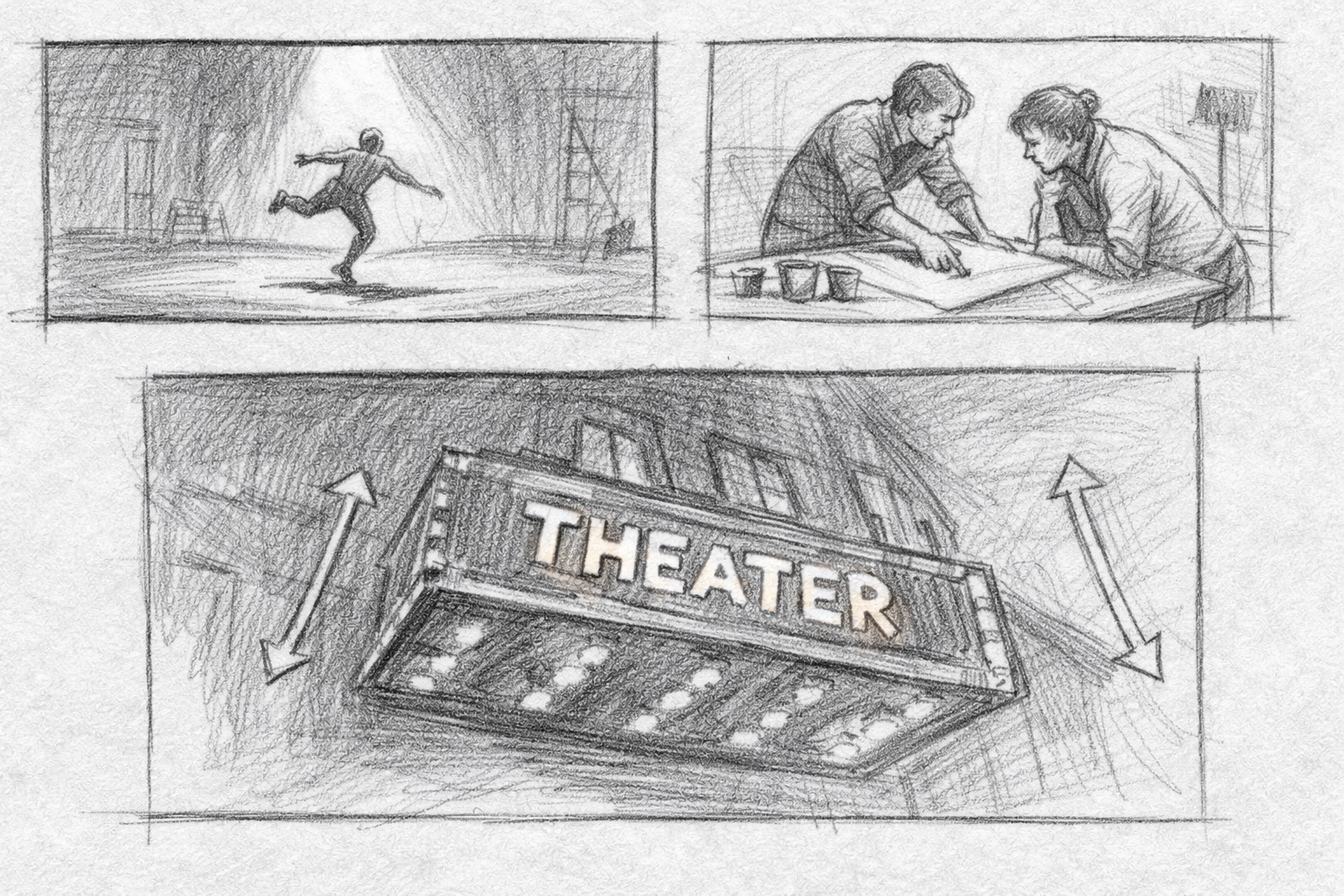
When Illinoise, a genre-defying dance-theater piece built from a cult Sufjan Stevens album, needed a producing partner willing to travel with it through the Fisher Center at Bard, Chicago Shakespeare, and Park Avenue Armory before anyone could say with confidence it would transfer to Broadway, ArKtype was there. Not as a late-stage amplifier, but as a long-term co-author of the project's life.
Similarly, Mara Isaacs and Octopus Theatricals were with Hadestown before it was anything like a safe bet. Isaacs came in during the development phase, when it was still a Vermont folk opera filtered through Depression-era Americana, and stayed for the better part of a decade. That’s not a commercial bet on a known property; that’s a long developmental commitment to something genuinely strange. The Tony wins didn't vindicate a safe choice; they vindicated an early one.
What’s interesting about both ArKtype and Octopus is that neither fits the traditional image of a commercial producer scanning the nonprofit landscape for transferable properties. They operate in the space between, with independent flexibility, without institutional overhead, and with a longer appetite for uncertainty. They function less like investors waiting for a sure thing and more like developmental partners who happen not to be nonprofits.
The Stalwarts of "What Needs to Exist"
This shift raises a question: if this is where early risk is increasingly living, what does that mean for the organizations that were built specifically to hold that space?
There are still organizations doing exactly that, and doing it in ways that make the distinction clear. Clubbed Thumb has spent thirty years producing work that isn't quite classifiable and doesn't need to be. Its programming logic isn't "what can transfer," but "what needs to exist." The result is a track record that reads like a map of where the American theater went before it actually got there.
New Georges has operated with similar consistency, maintaining a long-term commitment to supporting women directors and writers at the point when their work is still forming. Their investment is relational before it is productive.
Organizations like these aren't doing something nostalgic. They are doing something structurally different from what happens when season planning requires outside capital before a first draft is even finished. They are saying "yes" at the moment the field most needs someone to say "yes", before the work knows what it is.
The Role of the Creative Incubator
Nonprofit theaters are navigating very real pressures. Costs are up, audiences are shifting, and philanthropy is evolving. We’ve written before about why artists are self-producing more than ever, and these pressures are a big part of that.
But the risk doesn't disappear when one part of the system becomes more cautious. It moves.
The most interesting future is probably not one where nonprofits retreat from risk, or where commercial producers take it all on. It's one where the distinctions are clearer, even as the collaborations deepen. It's a world where nonprofits are not trying to behave like commercial producers, and commercial producers are not asked to fulfill a public mission they wasn't built for.
This is where a creative incubator like The Orchard Project fits in. Working outside the pressure of institutional seasons and 30% enhancement requirements, we can hold work at the moment it most needs to be held, before it's ready, before it's "legible," and before it has a clear financial pathway.
Whether we are helping a writer find the structure for a new episodic series or providing the space for a genre-bending performance lab project, our goal is to give the work time and serious attention before it needs to prove anything to the market.
Who Says Yes?
The ecosystem is more fluid than it used to be. Many of the most celebrated works of the past several years didn't emerge from a single institutional pipeline. They moved through a mix of nonprofit development, commercial interest, and independent momentum.
But the path usually starts with someone saying "yes" early.
Right now, it's worth pausing on a simpler question. When something truly early comes along, something that isn't fully formed, that doesn't have a clean path, that might even fail, who is most likely to say yes?
And maybe more importantly: Who do we want that to be?
For more updates on our process and the artists we support, check out the Open Process blog or see what's happening with The 2025 Orchard Project.
Leave a Reply